
Xenia City Directory Collections
The Greene County Room at Xenia Community Library is the clearest local starting point for historical directories. The library reports city directories dating to 1870, along with newspapers on microfilm dating to 1814, yearbooks, cemetery inscriptions, and a large local-history book collection. Its public material does not provide a complete title-by-title shelf list or prove an uninterrupted annual run. Treat the years below as explicitly documented coverage or named evidence, then ask staff about the particular volume needed.
| Collection | Years | Where Held | Access |
|---|---|---|---|
| Greene County Room historical directories | Dating to 1870 | Xenia Community Library, Greene County Room | Physical collection; request a title, publisher, and year inventory |
| Edmondson’s Xenia City & Greene County Directory | 1875–1876 | NPS historical-property bibliography; confirm local holding | Named early title and publisher evidence |
| Xenia City and Greene County Directory | 1881 | NPS historical-property bibliography; confirm local holding | Named Chandler Brothers and W. B. Chew evidence |
| 1915 Xenia directory | 1915 | Greene County Archives research article | Article reproduces or uses a directory image; inspect the volume for fields |
| Historic newspapers | Microfilm dates to 1814 | Greene County Room and its newspaper research channels | Use notices and obituaries to test a dated listing |
A date beside a title is not a promise that every intervening issue survives, that a reverse section exists, or that the printed series continued through a particular final year. The collection question to put to the Room is narrow: which title, publisher, year, and address section are available for the name or address in hand?
Xenia Directory Milestones
Ohio History Connection research places the first Xenia directory in 1870. It also records an 1866 health-officer ledger that inspected 835 properties in four wards around the Public Square, a useful reminder that local records existed before the directory series. The later named titles provide firm points on the shelf, but they should not be turned into a claim about one publisher or a continuous sequence.
| 1866 | A health-officer ledger recorded inspections of 835 properties in four wards around the Public Square. |
|---|---|
| 1870 | Ohio History Connection identifies Xenia’s first directory. |
| 1875–1876 | Edmondson’s Xenia City & Greene County Directory is identified in a National Park Service bibliography. |
| 1881 | An NPS bibliography identifies a directory compiled by Chandler Brothers and printed by W. B. Chew of Xenia. |
| 1915 | A Greene County Archives article uses or reproduces a Xenia directory image. |
The first-directory date makes an absence before 1870 unsurprising. For an earlier household, the health ledger, land records, newspapers, probate material, or census may be the better route. For a later household, a missing name can mean a different spelling, a skipped issue, a listing decision, or a move. It does not settle the question by itself.
Xenia Directory Research Desk
Greene County Room’s introduction to its local-history holdings documents the directory, microfilm, yearbook, and cemetery resources available in the Room.
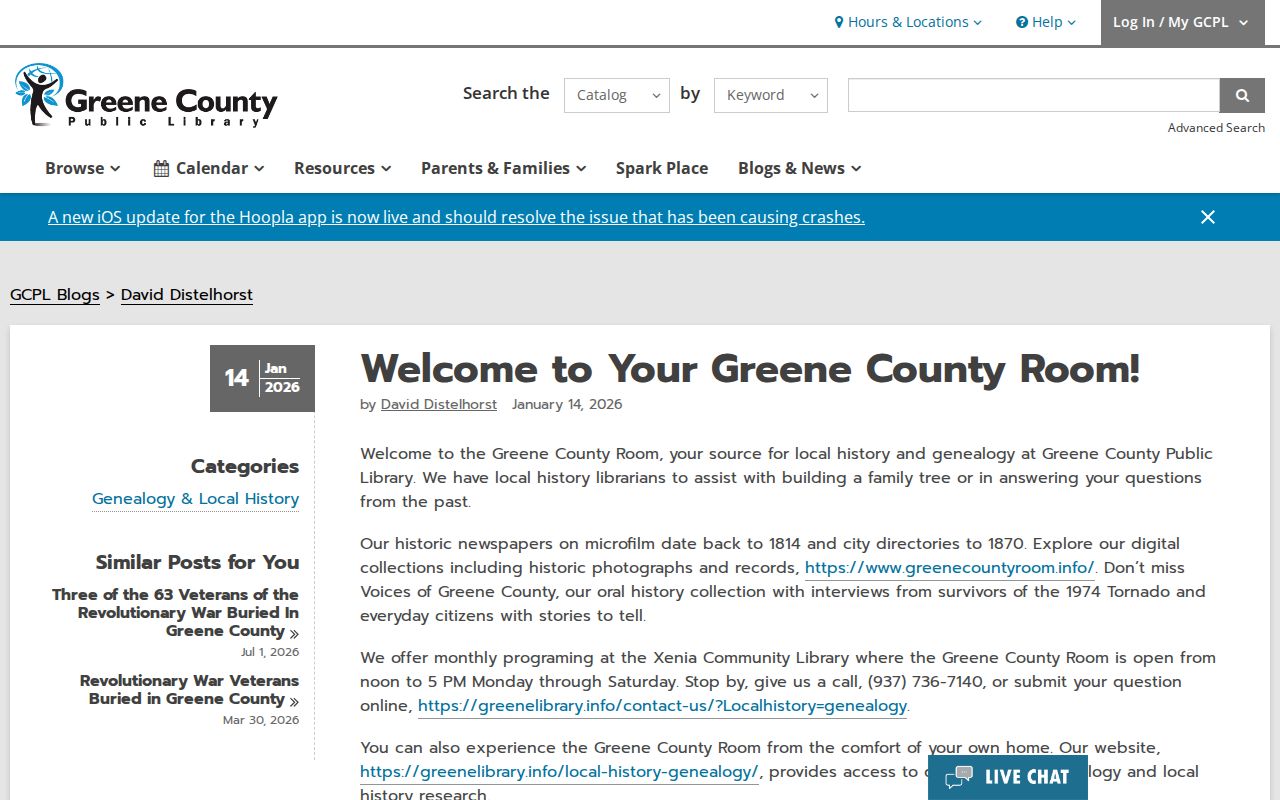
The room is inside Xenia Community Library and reports Monday through Saturday hours of noon to 5 p.m. Its listed phone is 937-736-7140. Patrons normally conduct their own research, while written requests may be handled as staff time permits. Local-history items can be noncirculating or fragile, so access, copying, and photography limits depend on the item. The published policy says personal-device scanning is free, most copies are $0.25 per page, and publication use needs archivist permission.
Before opening a volume, write down the surname variants, an approximate year, and a street name if one is known. Ask whether the particular volume has an alphabetical section, a street section, or both. That request is more reliable than assuming a complete run or a uniform arrangement across local publishers.
Reading a Xenia City Directory
No public Greene County Room page reviewed for this research displayed a digitized Xenia directory entry with exact field labels, a named sample person, or its volume’s abbreviation key. The inventory below is therefore an inspection checklist for a dated entry, not a reconstructed sample. Copy only what the selected volume actually prints, and record the title, publisher or imprint, year, and page or image number with the transcription.
| Exact printed name | Transcribe initials, spelling, suffixes, and punctuation as they appear. |
|---|---|
| Relationship wording | Record a spouse or widow notation only if the volume prints one. |
| Address | Capture the house number and street exactly, including any old form of the street name. |
| Other printed detail | Preserve any business, telephone, ownership, rental, or residence notation only when it is visible. |
| Abbreviation guide | Photograph or copy the guide in that same volume before interpreting its marks. |
- Criss-cross section
- An address-ordered part of a directory, if that particular volume includes one. It can connect a street address to listed names for the same publication year.
- Householder index
- An alphabetical name arrangement used to locate a printed listing. A directory may organize it differently, so inspect its title pages and headings.
- Abbreviation key
- The publisher’s own explanation of shortened words and symbols. Its meaning cannot safely be borrowed from another directory series.
Xenia Listings and Deeds
A directory and a land record answer different questions. A dated listing can show that a name and address appeared in a publication. A deed can identify parties to a recorded transfer. Neither alone is a complete household roster, and a directory entry should not be read as proof that the listed person owned the property. Compare the publication date with the event date on any land or probate record before drawing a connection.
The Greene County Room’s local history and genealogy resource page identifies directories as one part of a broader research collection.

For a historic address, use the literal directory wording as one dated clue. Then compare it with a recorder deed or tax transfer, a newspaper notice, and the closest released federal census. The comparison prevents a listed occupant, an owner of record, and a mailing recipient from being collapsed into one unsupported conclusion.
Xenia Directory Companions
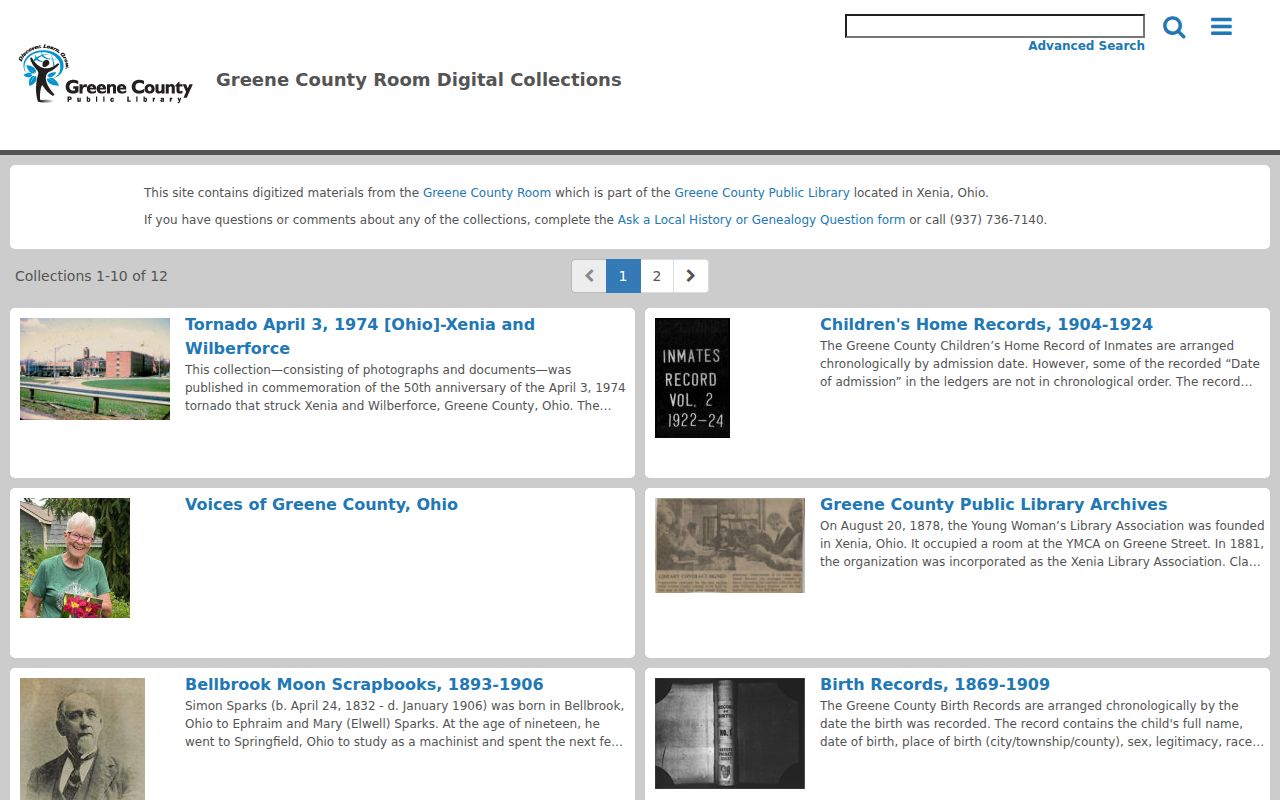
When a name appears in an old directory, the Greene County Room’s digital collections can supply the surrounding family or place context. Its online portal includes Greene County birth and death records from 1869 through 1909, Children’s Home Records from 1904 through 1924, church history, Women’s Club of Xenia material, local library archives, Voices of Greene County, WYSO archives, and material about the 1974 Xenia and Wilberforce tornado. These are separate collections, not extra pages of a directory series.
Greene County Room’s digital collections portal is the online route for those historical materials.
Use a birth, death, newspaper, or organization record to test dates, name forms, and local associations. Do not treat an image or transcription as a modern identity record. A 19th- or 20th-century listing establishes context for its own date only.
NewspaperARCHIVE is identified by the library as a channel for the Xenia Daily Gazette and other county titles. Ancestry Library Edition is reported as free inside a Greene County Public Library location, not necessarily from home. FamilySearch is another named research option. Each can help confirm a spelling or an address in the same period.
Trace a Xenia Directory Household
Work from one dated volume and leave a short source trail. The goal is to test continuity, not to force every year into a neat story. A move, a spelling change, a missed issue, a death, or a choice not to list can all explain a gap. Nearby directories, newspapers, and official record custodians help sort those possibilities.
- Choose the volume closest to a known address, life event, or census year. Record its title, publisher, date, page, and every literal detail that appears.
- Check the preceding and following available directory years for the same name and address. Note differences without assuming a reason.
- Inspect a same-year street or reverse section only if that volume has one. It may identify listed names at an address, not every household member.
- Compare the result with the closest released federal census, a recorder deed or tax transfer, and contemporary newspaper notices.
- Use probate, cemetery, obituary, or marriage evidence to close a historical trail when the documents support the event.
Note: A missing directory name is a prompt for another dated source, not proof that a person left Xenia or died.
Xenia Landmark Continuity
Historic-address work needs an extra check around landmarks and street context. The April 3, 1974 tornado altered downtown Xenia and Wilberforce landmarks, and documentation is now distributed among Greene County Room material, County Archives programs, Voices collections, and Wright State’s Dayton Daily News visual archive. That history cautions against assuming a familiar landmark or address description stayed unchanged. It does not establish that routine title or vital records disappeared.
Wright State Special Collections’ Catharine Greene DAR Chapter finding aid describes regional records that include minutes, yearbooks, scrapbooks, clippings, programs, photographs, genealogy, and membership-related administrative material.
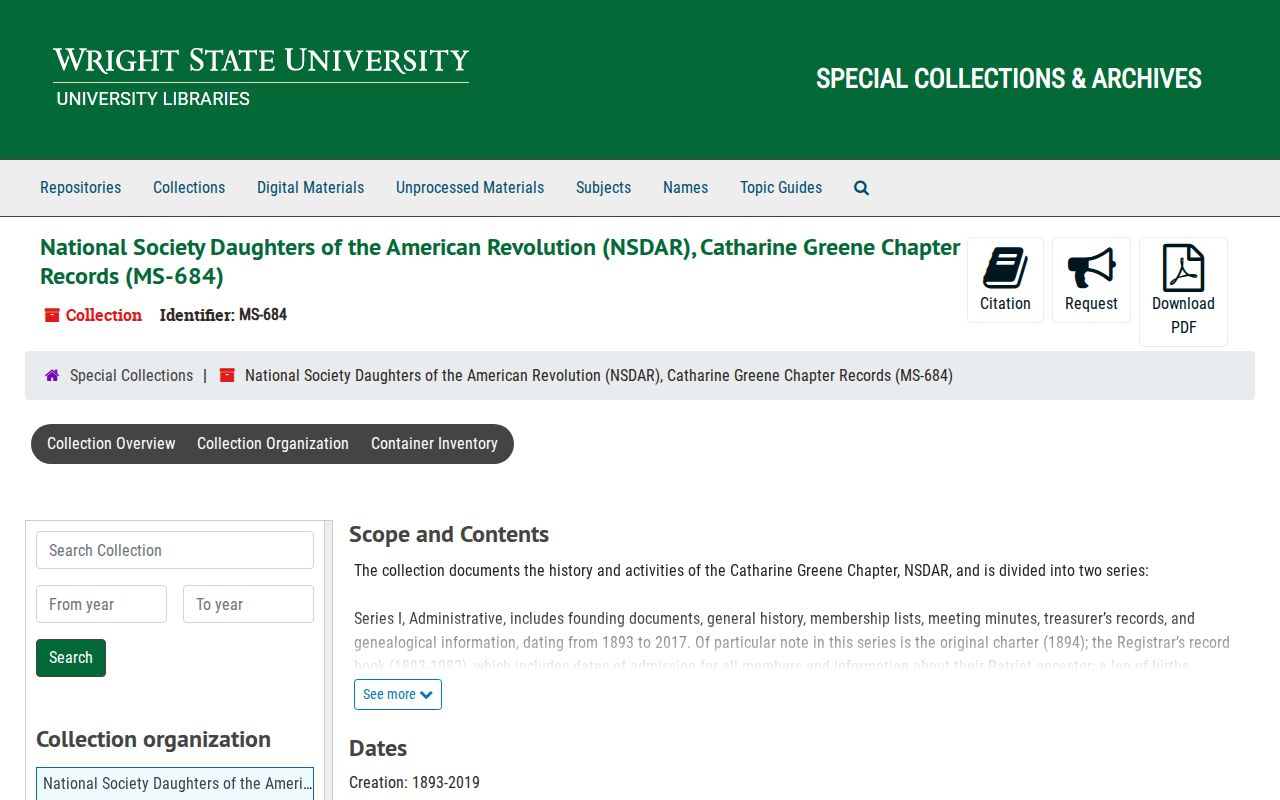
The collection covers 1893 through 2019 and transferred from the historical society in 2021. It is an archival companion for a documented historical question, not a searchable resident list.
Xenia Directory Fallbacks
When the local shelf does not settle a question, make the fallback fit the record type. The Greene County Archives, at 535 Ledbetter Road, keeps catalog, digital-record, map, and finding-aid resources. Its published guide places marriage records from 1803 through 2013 at Archives, wills and estates before 2018 there, and transcribed deeds from 1804 through 1864 there. The Recorder remains the route for deeds from 1803 forward, while Greene County Public Health is the stated route for birth and death records from 1909 forward.
For a marriage question, the Greene County Probate Court marriage resource reports online searching from October 1991 forward and directs earlier material to the Records Center and Archives Digital Repository. For university-related or regional material, Wright State Special Collections and Central State University’s appointment-based Special Collections may be more useful than a directory. The Greene County Historical Society is another local-history contact, but its public information does not claim a searchable resident database or a directory shelf inventory.