
Xenia Previous Residents by Era
A backward address trail should begin with the source that covers the period in question. The Recorder gives the recorded-instrument sequence, but its stated general online index begins later than many Xenia properties. The Greene County Room, Archives, historic maps, and released census records add earlier or household context. Coverage dates describe collection access, not a promise that every address appears in every year.
| Address source | Verified time span | Where to use it | What it can add |
|---|---|---|---|
| Recorder document index | 1984 forward | Recorder document search or counter | Instrument index and title-chain steps. |
| Earlier Recorder material | Scanning project advertised for 1803–1979; library reports deeds dating to 1925 | Recorder counter, books/images, and current-status inquiry | Earlier deeds and plats without asserting online completeness. |
| Greene County Room directories | Dates to 1870 | Xenia Community Library, Greene County Room | Dated listed addresses and households. |
| Historic newspaper microfilm | Dates to 1814 | Greene County Room and newspaper access routes | Notices, obituaries, and local address events. |
| Sanborn maps | 1885, 1890, 1895, 1901, 1910, and 1919 | Greene County Room and Library of Congress | Building and street-context comparison. |
| Federal census | Historical released records; 1950 latest public release at research date | Census and library genealogy access | Decennial household and area evidence. |
Begin with the current parcel even for a very old house. The owner field, situs address, parcel number, and legal description provide the stable facts needed to cross from today’s property system into older records. A different tax mailing address should be copied as correspondence information only, not as proof that the owner lived at the property.
Xenia Address History Starts With Land
Use the Greene County Auditor property search to capture the current parcel number, situs address, legal description, and owner. The Auditor describes its real-estate records as covering ownership, property address, legal description, transfers/conveyances, value, building description, footprint, and listed credits. That makes it an address-keyed starting record, not a statement of every person who has lived at the property.
The legal description does the most work when the street form changes. It may name a lot and block, a plat reference, or a survey-based description. On an older Greene County record, that wording can carry the investigation through a renamed street, renumbered address, or a new plat-cabinet citation. Preserve punctuation, lot numbers, and references rather than reducing it to a modern address label.
- Grantor
- The party transferring an interest in a recorded instrument, commonly the earlier owner in a deed trail.
- Grantee
- The party receiving that interest. The current owner’s acquisition deed names the prior grantor.
- Chain of title
- The sequence of recorded transfers used to follow an interest in land backward through time.
- Criss-cross directory
- An address-arranged directory, when the exact historical volume includes one, that can identify a dated listed occupant.
- Enumeration district
- The geographic area used for a census count. It helps test an address only after the street form is established.
Trace Xenia Previous Residents by Deed
Deeds identify recorded transfers, not every occupant. They are still the best way to build the ownership backbone for a Xenia address. The Recorder says its work is to keep and index land records so documents can be found and a chain of title can be established. Follow one complete transfer at a time and keep the land description with the name sequence.
- Copy the current owner and legal description from the Auditor parcel record.
- Use the Recorder Document Search to find the owner’s acquisition instrument. The available modes include All Names, Instrument Number, Book / Page, Parcel ID, and Historic Indexes.
- Record the prior grantor, recording date, and any instrument or book/page reference shown. Then search that prior party as grantee to locate an earlier acquisition.
- Repeat the sequence while comparing legal descriptions and plat references. A mismatch is a reason to pause and resolve the land description before proceeding.
- When the web index stops or an image is missing, shift to the Recorder counter, available books or microfilm, and Archives material instead of assuming the online chain is continuous.
Recorder copies are available through the document-search route or at the office. Internet images are informational and watermarked. Official unwatermarked copies are available at the counter. The stated copy choices are self-service, staff-made, and phone order, so a record that needs close verification can be obtained through the appropriate channel rather than relying only on a screen image.
Xenia Recorder Index and Image Gap
The key Xenia quirk is that the stated web-index start and image availability are not the same thing. Greene County publishes a general index beginning in 1984. Most instrument images begin January 1, 1995. Yet its image inventory lists condominium, plat, and street-name-change searches from January 1, 1803 when searched by name. These categories should not be flattened into a claim that every early deed is online.
The Recorder has advertised a scanning project for 1803–1979, while the Greene County Room reports Recorder deeds dating back to 1925. Those statements describe different record and access contexts. For a pre-index Xenia address, contact or visit the Recorder and ask which books or images are available, then use the Archives and library collections as additional routes.
Note: An index result can exist without an online image, and a web image can require a counter copy for official verification.
Xenia Address Changes and Plats
A historic street search can break when a house number, street name, boundary, or plat reference changed. The Greene County historic-property guide recommends tracing the legal description through plats, deed indexes, and tax duplicates. For eastern Greene County, older descriptions can use Military Survey numbers; west-side descriptions can use range, township, and section terms. They are not interchangeable, but each can be the bridge across address changes.
Greene County converts Plat Books 1 through 29 and Condo Books 1 through 3 to a new Plat Cabinet/Page reference. Search Book/Page and check the Remarks field for the conversion. Plats after March 11, 1994 use a Plat Cabinet. The 2025 Towne Square replat also shows why a current address can require City, Postal Service, 911, and county-tax alignment. Check records against the land description, not a street name in isolation.
Xenia Past Residents in Directories
Once a deed trail has supplied a period and address form, historical directories can add the occupant layer. The Greene County Room holds city directories dating to 1870, along with newspaper microfilm dating to 1814. An address or reverse section is useful only when it appears in the exact volume used. A normal name directory, a directory listing, and a deed answer different questions and should stay labeled that way in a house-history timeline.
For a former Xenia household, record the directory title, year, street spelling, number, and listed name. Then compare that entry with a map or newspaper from the same period. The 1866 health-officer ledger and the first city directory in 1870 show that local address-oriented historical material can predate a modern street form. For collection context, see the Xenia city directories reference.
Xenia Directory and Census Pairing
Directories are annual or irregular local publications. Census records are decennial. Use the directory first to place a likely household and street form in a particular period, then use ward, map, or enumeration-district context to test a census record. The 1950 census was the most recent released public decennial census at the research date. It can add household composition for its date, not an annual address history.
- Choose a directory year that falls near the period established by the deed chain.
- Check whether the exact volume includes a street or reverse listing and preserve the address as printed.
- Compare the street with a contemporary Xenia map or Sanborn sheet before assuming it matches today’s number.
- Use the census only after the address and area are reasonably placed. Treat a plausible name match as a lead to verify, not a conclusive address match.
The Library of Congress Xenia Sanborn set includes sheets for 1885, 1890, 1895, 1901, 1910, and 1919. The Greene County Room also directs home-history researchers to Sanborn maps and can help them use Recorder deeds. Map comparison is particularly valuable when a building was altered, a street was reworked, or the number sequence does not align.
Xenia Previous Residents at Archives
The Greene County Archives is the early-record fallback for a trail that extends beyond a portal. It has a catalog, digital records, maps, finding aids, and reference-request material. Its FAQ places transcribed deeds from 1804–1864 at the Archives and says Recorder deeds run from 1803 forward. The Archives also holds marriage records for 1803–2013 and wills and estates before 2018, useful as dated family-history context when the address trail already points to a person or property.
The Greene County Archives provides the source view shown here.
The Archives offers a route to older land, map, and local records that should be used alongside, rather than as a substitute for, the Recorder’s title sequence.
Its formal program began in 1996 after permanent county material had been stored in several scattered locations. That history describes preservation and management, not a blanket loss of courthouse records. A 1974 tornado damaged the historical-society museum campus, but the reviewed sources do not support a claim that routine county title or vital records disappeared.
Visit Xenia Archives for Earlier Records
For material that cannot be confirmed online, the Archives lists an in-person research route at 535 Ledbetter Road in Xenia. Posted hours are Monday through Friday, 9 a.m. to 4 p.m., and the reference phone is 937-562-6487. A visit is especially useful for maps, finding aids, early deed research, and a record group whose online status is uncertain.
The Archives visiting information is shown in this captured view.
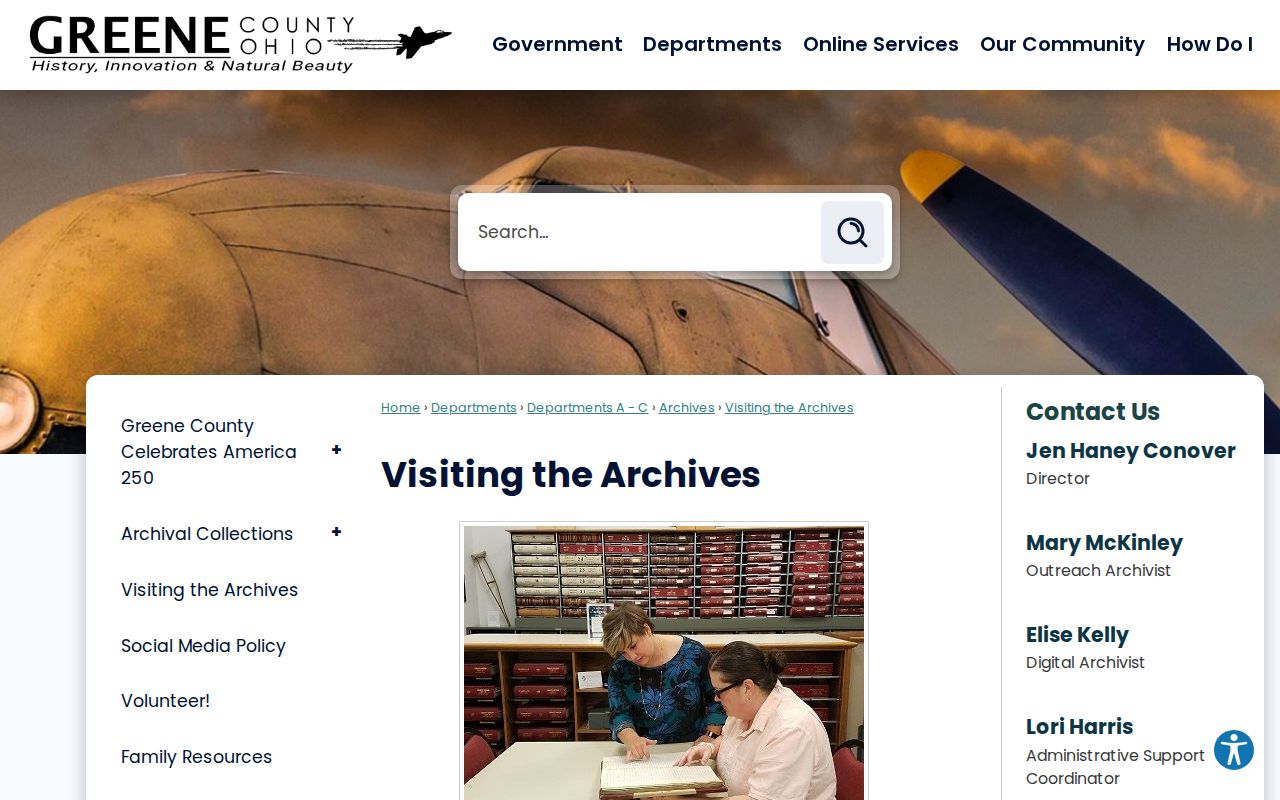
Bring the parcel number, legal description, known names, date range, and any book/page or instrument reference. That concise description lets staff identify existing records without being asked to reconstruct an entire household history.
The Recorder and Archives are complementary access channels. The Recorder supplies the current document-search portal and counter, while the Archives adds catalog, maps, finding aids, digital records, and reference-request support for older material. County public-record requests may also be made by website, email, mail, fax, drop-off, or in person to the relevant department.
Xenia Previous Residents and Death Records
An obituary, probate file, cemetery record, or death record can provide a dated endpoint for a person connected to an older address. It does not by itself prove that the person lived there on a particular date. Cross-check the date and identity against the directory, deed, map, or estate file already in the trail. Greene County Room digital birth/death records cover 1869–1909, and death/birth records from 1909 forward are routed through Greene County Public Health.
The Ohio historical death certificate search provides the source view captured here.
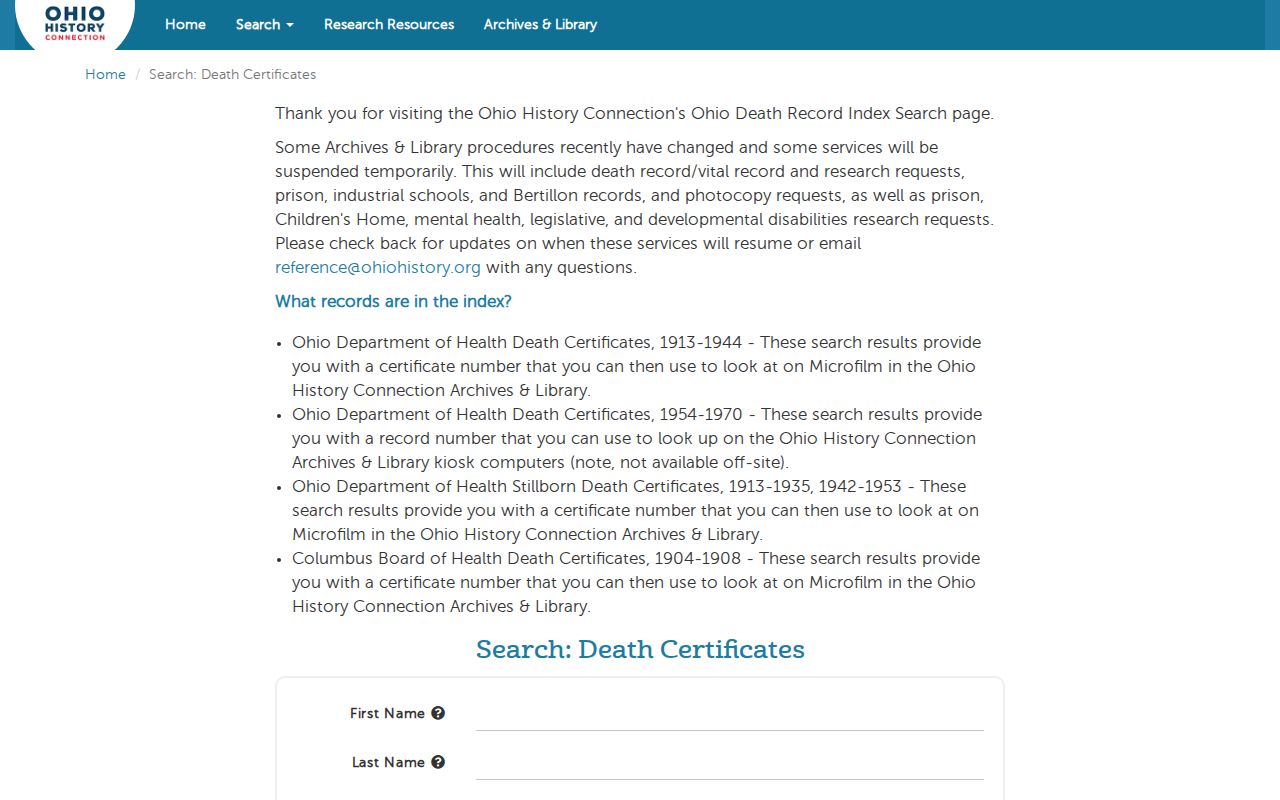
A historical death-search result can help test dates and names in a Xenia address history, but the property and occupancy connection still needs support from local records.
Xenia Previous Residents Privacy
House-history research has clear limits. Recorded ownership, a dated directory listing, a map label, and a historical notice are not a complete record of everyone who lived in a home. Current personal address information, protected voter data, driver records, utility accounts, and unrecorded arrangements are not established by the parcel and deed systems.
Lawful use. Use Xenia previous-resident records for family history, house history, personal research, or civic curiosity. Do not use what you find to stalk, harass, intimidate, or harm any person.
Keep a source log that separates owner, property, listed occupant, and life-event evidence. When a record conflicts, return to its custodian and date rather than filling the gap with an assumption. That approach preserves both the Xenia address trail and the privacy of living people.